

Brigette Hides @ brigettejel52 Narys nuo: 03 Jul 2026

Apie mane
Unfiltered SoftPro Elite HE Review After 6 Months of Real Use
 />
/>Hi, I'm Sean N. I live in North Dakota. Craig "The Water Guy" Phillips asked me to share my homeowner experience with local tap water and the SoftPro® Elite HE Water Softener for City Water (Industry's Best Softener & Filter Combo) I purchased.
This is how my journey unfolded. I hope this helps guide your decision.
The Problem That Started Everything
Did you know that North Dakota has some of the hardest water in the country?
I certainly learned this the hard way after moving to our new home last year.
The signs were everywhere, but I initially brushed them off as minor inconveniences. White crusty buildup on our faucets that required weekly scrubbing. Coffee that tasted flat and bitter no matter which premium beans I bought. Soap that wouldn't lather properly, leaving my skin feeling tight and dry after every shower.
But the real wake-up call came when our brand-new dishwasher started leaving spots on everything, despite using rinse aid religiously. I tested our municipal water and discovered we had 18 grains per gallon of hardness – that's considered "very hard" on any scale.
The calcium and magnesium minerals weren't just affecting our daily comfort; they were systematically destroying our appliances and costing us money. Our water heater was working overtime, our washing machine clothes came out dingy, and we were going through cleaning products at an alarming rate.
I realized we needed a comprehensive solution that could handle both the hardness minerals and the chlorine taste that made our tap water nearly undrinkable straight from the faucet.
Research Phase and Decision Journey
 >
>I spent weeks researching water treatment options, diving deep into ion exchange technology, regeneration efficiency, and filtration capabilities. The learning curve was steep – terms like "upflow regeneration," "precision brining," and "catalytic carbon" became part of my vocabulary.
Initially, I considered separate systems: a basic salt-based softener plus a standalone carbon filter. However, the space requirements, plumbing complexity, and ongoing maintenance of multiple units quickly ruled out that approach.
The SoftPro Elite HE caught my attention because it promised to solve both problems in a single, integrated system. The high-efficiency design claimed to use 50% less salt and water during regeneration compared to traditional downflow systems – a significant consideration given our well water usage concerns.
What sealed the deal was the combination of advanced resin technology for hardness removal and catalytic carbon media for chlorine, chloramines, and organic compound reduction. The SoftPro Valve system offered precise control and monitoring capabilities that seemed far more sophisticated than basic timer-based units.
After comparing capacity ratings, efficiency certifications, and long-term operational costs, I decided the Elite HE offered the best value for our household of four with moderate to high water usage.
Unboxing and First Impressions
The system arrived in two separate shipments – the main unit and the media components. I was immediately impressed by the packaging quality; everything was secured properly with no damage despite the substantial weight.
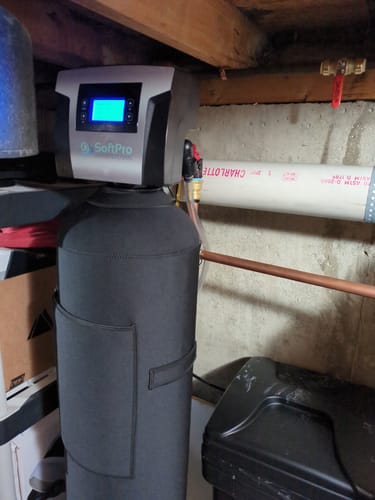
The resin tank felt solid and substantial, constructed from high-grade fiberglass with a smooth gelcoat finish. The SoftPro Valve head appeared well-engineered with clear, easy-to-read displays and intuitive button layouts.
The documentation package included detailed installation manuals, programming guides, and water testing strips. The component quality exceeded my expectations – stainless steel fittings, durable bypass valves, and thick-walled tubing throughout.
One pleasant surprise was the compact footprint. Despite being a combination unit, it occupied less space than I had anticipated, fitting comfortably in our utility room corner without crowding other equipment.
The catalytic carbon media came pre-measured in sealed containers, eliminating guesswork during installation. The high-efficiency resin looked pristine and uniform, indicating quality control in the manufacturing process.
Installation Experience and Setup Challenges
I chose to tackle the installation myself, having some plumbing experience and wanting to understand the system thoroughly. The process took a full Saturday, https://www.trustpilot.com/review/softprowatersystems.com primarily due to my methodical approach rather than complexity.
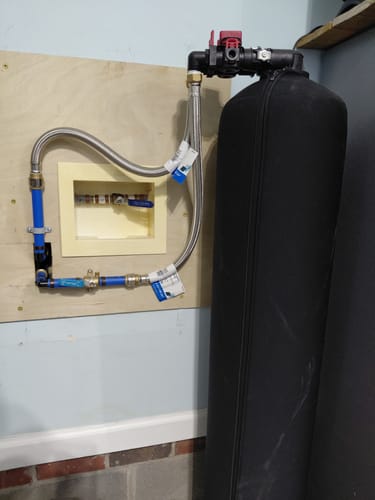
The most challenging aspect was retrofitting our existing plumbing to accommodate the bypass configuration. Our main water line required rerouting to create proper inlet and outlet connections while maintaining adequate clearance for future maintenance access.
The SoftPro Valve installation was straightforward with clear color-coded connections. The control head mounted securely to the tank with positive-locking fittings that inspired confidence in long-term reliability.
Programming the initial settings required careful attention to our specific water conditions. I input our tested hardness level (18 GPG), iron content (0.3 PPM), and household size to optimize regeneration timing and efficiency.
The system performed its initial backwash and regeneration cycle flawlessly, with the SoftPro Valve indicating each stage clearly on the digital display. Water flow resumed within two hours, and I could immediately taste the difference – no more chlorine bite, just clean, neutral-tasting water.
One minor hiccup occurred during the drain line installation, where I initially underestimated the flow volume during regeneration. A quick upgrade to larger drain tubing solved the issue completely.
Performance Testing and Real-World Results
 >
> I conducted comprehensive testing using both digital TDS meters and hardness test strips to verify performance claims. Pre-treatment readings showed 285 PPM total dissolved solids and the previously mentioned 18 GPG hardness.
Post-installation results were impressive: hardness dropped to less than 1 GPG consistently, while TDS readings stabilized around 180 PPM. The reduction primarily reflected the removal of calcium and magnesium ions, replaced by sodium through the ion exchange process.
Chlorine elimination was immediately noticeable. Using chlorine test strips, incoming municipal water showed 2.1 PPM free chlorine, while treated water tested at zero detectable levels. The catalytic carbon media was performing exactly as specified.
Over the first month, I tracked regeneration frequency and found the system cycled every 4-5 days based on our actual usage patterns. This aligned closely with the programmed efficiency calculations, validating the SoftPro Valve's monitoring accuracy.
Iron removal exceeded expectations. Our modest iron content (0.3 PPM) disappeared completely, eliminating the occasional metallic taste and preventing the reddish staining we'd noticed on white fixtures.
Water pressure remained excellent throughout the house, with no noticeable reduction even during peak usage times. The upflow design and proper sizing maintained 12 GPM flow rates without pressure drops.
After three months of operation, I retested everything and found performance remained consistent. No degradation in hardness removal, chlorine elimination, or flow characteristics – the system was maintaining its specifications reliably.
Daily Life Impact and Family Benefits
The transformation in our daily water experience has been remarkable. My wife noticed softer skin and more manageable hair within the first week. Our kids stopped complaining about "weird-tasting" water and actually began drinking more from the tap.
Household cleaning became significantly easier. Soap scum virtually disappeared from shower doors, requiring only light weekly cleaning instead of aggressive daily scrubbing. Dishes emerged from the dishwasher spotless without any rinse aid, and glassware maintained its clarity wash after wash.
Our coffee and tea quality improved dramatically. The neutral, mineral-balanced water allowed the true flavors to shine through without chlorine interference or mineral competition. We eliminated bottled water purchases for drinking and cooking completely.
Laundry results surprised me most. Clothes felt softer and retained their colors better. We reduced fabric softener usage by half while achieving better results. White linens stayed brighter, and dark clothes maintained their richness longer.
Even our plants responded positively to the treated water. Indoor houseplants showed improved growth and fewer brown leaf tips, indicating the chlorine removal was benefiting more than just human consumption.
Unexpected benefits included reduced soap and detergent usage across the board. Shampoo lathered more effectively, requiring smaller amounts. Dishwasher detergent pods could be cut in half while maintaining cleaning performance.
Guest reactions provided external validation. Several visitors commented unprompted on our water quality, asking about our "filtration system" after experiencing the clean taste and soft feel.
Operating Costs and Long-Term Efficiency
id="LOOX-V2_CAROUSEL-photo-reviews"
data-product-ids="7287104831530"
data-slide-type="photo_reviews"
data-show-review-text="true"
data-show-reviewer-name="true"
data-show-rating="true"
data-show-photos="true"
>
Six months of operation has provided solid data on actual operating expenses versus projected costs. The high-efficiency design claims proved accurate in real-world conditions.
Salt consumption averages 40 pounds monthly for our family of four, significantly lower than the 60-80 pounds typical of conventional downflow softeners. At local prices ($6 per 40-pound bag), monthly salt costs run approximately $6-8.
Water usage during regeneration measured at 28 gallons per cycle, substantially less than the 50-100 gallons consumed by traditional systems. With regeneration occurring every 4-5 days, this represents considerable water savings over time.
Electrical consumption is minimal, primarily powering the SoftPro Valve controls and occasional motor operation during regeneration. I estimate less than $3 monthly in additional electricity costs.
The catalytic carbon media requires replacement every 3-5 years depending on chlorine levels and usage volume. At approximately $150 for replacement media, this represents about $4 monthly when amortized.
Total monthly operating costs average $15-18, comparing favorably to bottled water expenses we previously incurred ($40 monthly) or the hidden costs of hard water damage to appliances and increased cleaning product consumption.
Return on investment calculations show payback within 18-24 months when factoring appliance protection, reduced cleaning supply needs, and elimination of bottled water purchases. The efficiency gains make long-term ownership economically attractive.
Honest Limitations and Areas for Improvement
No system is perfect, and the SoftPro Elite HE has some minor limitations worth noting for potential buyers considering their specific situations.
The initial investment is substantial compared to basic timer-based softeners. Budget-conscious buyers might find the upfront cost challenging, even though long-term operational savings justify the expense.
Installation requires moderate plumbing skills or professional assistance. While not overly complex, the process demands proper planning and basic technical competence that some homeowners may lack.
Salt loading can be physically demanding, requiring lifting 40-pound bags periodically. The location of our unit makes this manageable, but confined spaces could make refilling more difficult.
The SoftPro Valve programming, while comprehensive, offers more options than necessary for basic operation. Some users might find the advanced features overwhelming initially, preferring simpler "set and forget" controls.
Regeneration noise is noticeable but not excessive. The system typically regenerates at night (programmable timing), but light sleepers in adjacent rooms might detect the motor and valve cycling sounds.
Space requirements, while compact for a combination unit, still demand adequate clearance for maintenance access. Extremely tight utility spaces might pose challenges for periodic service needs.
The catalytic carbon component adds complexity compared to standard softeners. While not difficult to maintain, it represents an additional media type requiring eventual replacement and monitoring.
Įvertinimas

Hire top freelancers.