

Elliott Eldred @ elliottk695519 Narys nuo: 01 Jul 2026

Apie mane
SoftPro Elite HE Water Softener Review Real Results From Home

 />
/>Hi, I'm Parsons C.. I live in Charlotte. Craig "The Water Guy" Phillips asked me to share my homeowner experience with local tap water from the city using the SoftPro® Elite HE Water Softener for City Water (Industry's Best Softener & Filter Combo) that I purchased. This is how my adventures played out. I hope this helps you in your decision.
When I first noticed those white, crusty deposits building up on my kitchen faucet and shower doors, I honestly thought it was just part of homeownership. My coffee maker started taking forever to brew, and I was constantly scrubbing mineral buildup from every fixture in the house. The final straw came when my wife complained about her hair feeling dry and brittle after every shower, despite using expensive conditioners.
After eight months of living with the SoftPro Elite HE system, I can tell you this thing works great – but there's so much more to the story than just "it works." Let me walk you through everything: the problems that led me here, the research nightmare, installation day, real performance data I've collected, and honestly, some frustrations I didn't expect.
The Hard Water Reality That Made Me Take Action
Did you know that Charlotte's municipal water contains an average of 5-8 grains per gallon of hardness minerals?
That might not sound like much, but when I started paying attention to what this was actually costing me, the numbers were shocking.
My dishwasher, barely two years old, already had white film coating the interior walls. I was using twice as much laundry detergent as the bottle recommended just to get clothes clean. Our glass shower doors looked permanently fogged, no matter how much I scrubbed with CLR and other harsh chemicals.
But the real wake-up call came when our HVAC technician pointed out mineral buildup in our water heater during routine maintenance. He explained that calcium and magnesium – the primary culprits in hard water – create scale deposits that force appliances to work harder and fail sooner. I was looking at potentially replacing a $1,200 water heater years ahead of schedule.
The health and comfort issues were equally frustrating. My skin felt tight and itchy after showers, especially during winter months. My wife's naturally curly hair became unmanageable and frizzy. We were spending extra money on moisturizing soaps, leave-in conditioners, and skin lotions – costs that add up when you're treating symptoms instead of the root cause.
I tested our water with a basic hardness kit from the hardware store and got readings consistently around 7 grains per gallon. According to the Water Quality Association, anything above 3 grains is considered moderately hard, and above 7 grains qualifies as hard water requiring treatment.
Research Phase: Learning What I Actually Needed
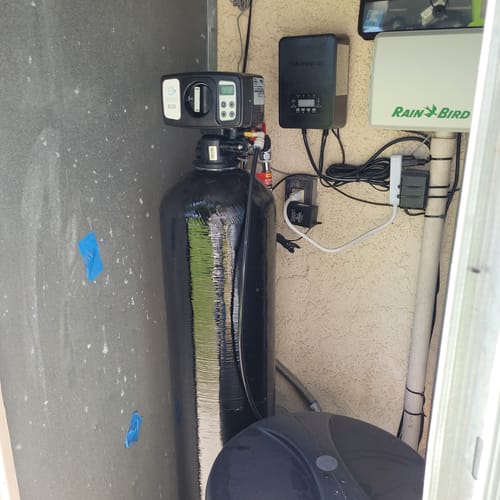 >
>Initially, I thought all water softeners were basically the same – just salt tanks that somehow made water "softer." I was completely wrong, and diving into the research revealed a complex world of technologies, capacities, and efficiency ratings that frankly overwhelmed me at first.
I discovered there are fundamentally different approaches to treating hard water. Traditional salt-based ion exchange systems actually remove calcium and magnesium ions by swapping them with sodium ions. Salt-free systems, technically called water conditioners, don't remove minerals but claim to prevent them from adhering to surfaces through crystallization or other methods.
For our situation – municipal water with moderate hardness levels – multiple sources pointed toward salt-based systems as the most proven technology. The science is straightforward: hard water flows through a resin bed where calcium and magnesium ions are captured and sodium ions are released. Periodically, the system regenerates by flushing the resin with brine solution.
Sizing calculations became crucial. Our household of four people uses approximately 250 gallons per day on average. With 7-grain hardness, that means processing about 1,750 grains of hardness daily. I needed a system with sufficient capacity to handle several days of usage between regeneration cycles.
The SoftPro Elite HE caught my attention because it combines traditional water softening with additional filtration stages. Living in an urban area, our municipal water contains chlorine, chloramines, and trace contaminants that affect taste and odor. Having both functions in one system appealed to me from space and maintenance perspectives.
What sealed the decision was the high-efficiency design. Traditional softeners regenerate on preset timers, regardless of actual usage. The Elite HE uses metered regeneration, meaning it only regenerates when the resin bed is actually exhausted based on water usage and hardness levels. This reduces salt consumption and water waste significantly.
Unboxing and Initial Assessment
The system arrived via freight delivery, which I should have expected given its size and weight. The main control head and tank assembly weighed around 150 pounds, plus a separate brine tank that I could handle alone. Everything came wrapped in heavy-duty plastic with foam protection at key contact points.
First impression: this thing is built like a tank. The control valve body is solid brass construction, not plastic like some budget units I'd seen. The resin tank uses a fiberglass construction with a seamless interior coating. Even the brine tank felt substantial – thick polyethylene walls with a well-designed salt grid system at the bottom.
The included installation kit was comprehensive but not overwhelming. All necessary fittings, bypass valve, drain line, and overflow assembly came in clearly labeled bags. The installation manual was actually readable, with proper diagrams and step-by-step photos instead of confusing line drawings.
I appreciated finding a water testing kit included in the box. It contained test strips for hardness, chlorine, pH, iron, and total dissolved solids. Testing our water before installation gave me baseline numbers to compare against later.
One pleasant surprise was the compact footprint. I'd measured our utility room carefully, but the system took up less floor space than expected. The cylindrical design uses space more efficiently than rectangular units, and the control head sits directly on top rather than offset to the side.
Installation Experience and Setup Process
I'll be honest – I considered hiring a plumber for installation, but decided to tackle it myself after watching SoftPro's installation videos online. The process took me about six hours spread across a Saturday, including several trips to the hardware store for additional fittings.
The most challenging aspect was installing the bypass valve in our main water line. I had to shut off water to the entire house, cut into the existing copper pipe, and solder new fittings. If you're not comfortable with basic plumbing, this step definitely warrants professional help. A skilled plumber could probably complete the entire installation in 2-3 hours.
Positioning the system required some planning. The resin tank needs to connect to the brine tank with a small diameter tube, so they can't be too far apart. Both units need level placement, and the brine tank requires easy access for adding salt. I ended up rearranging some storage shelves to create an optimal layout.
The electrical connection was straightforward – just a standard 110V outlet. The control head draws minimal power, mainly for the digital display and valve motor operation. There's a battery backup that maintains programming during power outages, which has proven useful during a few storm-related outages we've experienced.
Initial system programming required inputting our water hardness level, iron content (minimal in our case), and household size. The control head uses this information to calculate optimal regeneration timing and salt dosing. I appreciated being able to adjust regeneration time to 2 AM when we're not using water.
The first regeneration cycle was fascinating to watch. The system automatically initiated the process about three days after installation, based on calculated resin exhaustion. The entire cycle took approximately 90 minutes, using about 12 gallons of water and producing a gentle humming sound during valve transitions.
Performance Testing and Real-World Results
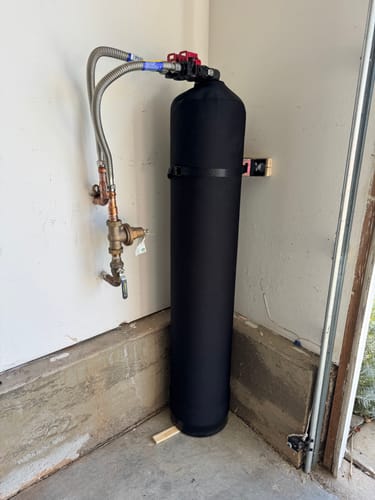 >
> I'm a bit of a data nerd, so I documented everything with before-and-after measurements. Pre-installation hardness readings consistently showed 6.8-7.2 grains per gallon. Post-installation readings dropped to 0-0.5 grains per gallon – essentially zero hardness.
The transformation in daily life became apparent within the first week. Our dishwasher started producing spotless glassware again. I no longer needed rinse aid, and even heavily soiled dishes came out clean with standard detergent amounts. The interior walls of the dishwasher, previously coated with white film, gradually cleared up over several wash cycles.
Laundry improvements were equally dramatic. Clothes felt softer and brighter using 25% less detergent than before. White t-shirts that had developed a gray tinge from mineral deposits started looking white again after several wash cycles. My wife's dark jeans maintained their color vibrancy instead of fading to gray.
Shower and bath experiences improved significantly. Soap lathered easily and rinsed completely, leaving skin feeling soft instead of tight and dry. My wife's hair became more manageable and less frizzy. We stopped needing heavy moisturizers after every shower.
I measured water flow rates before and after installation to check for pressure drops. Our main line pressure runs about 55 PSI, and I measured 52 PSI after the softener – a minimal 3 PSI reduction that's not noticeable during normal usage. Even with multiple fixtures running simultaneously, pressure remained adequate.
The filtration component effectively removed chlorine taste and odor from our municipal water. Before installation, tap water had a noticeable chemical taste, especially in the morning. Now our tap water tastes neutral and clean – we've stopped buying bottled water for drinking.
Iron removal, https://www.trustpilot.com/review/softprowatersystems.com while not a major issue for us, has been effective. Occasional reddish staining in our guest bathroom toilet disappeared completely. The system specifications indicate it can handle up to 8 PPM of clear water iron, well beyond what most municipal water systems contain.
Daily Operation and Maintenance Reality
Living with the system day-to-day has been remarkably hassle-free. The control head displays current operating status, days until next regeneration, and salt level warnings. I check it briefly during my weekly utility room inspection but rarely need to take action.
Salt consumption averages about 40 pounds per month for our household of four. I buy salt in 50-pound bags from the hardware store, costing around $6 each. The brine tank holds approximately 200 pounds, so I add salt every 4-5 months depending on usage patterns.
The type of salt matters more than I initially realized. I started with standard rock salt but switched to solar salt pellets after noticing residue buildup in the brine tank. Solar salt dissolves more completely and leaves fewer impurities. Iron-fighting salt isn't necessary for our municipal water, but it's available for well water applications.
Filter cartridge replacement occurs every 6-8 months depending on water usage and local water quality. The system alerts me when replacement is due, and changing cartridges takes about 10 minutes. Replacement cartridges cost around $45-50 and are readily available online.
I've performed basic maintenance like cleaning the brine tank and checking salt bridges (hardened salt formations that prevent proper dissolution). The tank design makes cleaning straightforward – I empty remaining salt, rinse with warm water, and refill. This process takes about 30 minutes and is needed roughly once per year.
Regeneration cycles occur every 3-4 days based on our usage patterns. The system automatically adjusts timing based on actual consumption rather than preset schedules. During vacation periods when we're away, regeneration frequency drops accordingly, saving salt and water.
System monitoring has become second nature. The digital display shows remaining capacity, current water flow, and time until next regeneration. Error codes appear if problems arise, though I haven't experienced any issues requiring service calls in eight months of operation.
Cost Analysis and Long-Term Value
id="LOOX-V2_CAROUSEL-photo-reviews"
data-product-ids="7287104831530"
data-slide-type="photo_reviews"
data-show-review-text="true"
data-show-reviewer-name="true"
data-show-rating="true"
data-show-photos="true"
>
Initial system cost was $1,847 including shipping, which positioned it in the mid-range of whole-house water treatment options. Professional installation would add $400-600 depending on local rates and complexity. I saved money doing it myself but invested considerable time learning and executing proper installation.
Monthly operating costs break down to approximately $15-20 total. Salt averages $6-8 per month, filter replacements add $6-7 monthly when amortized, and electricity consumption is minimal – maybe $2-3 per month for the control head and valve operation.
The value calculation becomes interesting when considering avoided costs. I no longer buy bottled water, saving $25-30 monthly. Soap, detergent, and personal care product usage has decreased by roughly 25%, saving another $15-20 monthly. Reduced cleaning time and harsh chemical purchases add additional value that's harder to quantify.
Appliance protection represents significant long-term value. Our water heater, dishwasher, washing machine, and ice maker should last longer without constant mineral buildup. Replacing a water heater prematurely costs $1,200-1,500, making the softener investment worthwhile for appliance protection alone.
Energy efficiency improvements are measurable. Scale buildup forces water heaters to work harder, increasing energy consumption. Our utility bills show a modest decrease in gas usage since installation, though seasonal variations make precise calculations difficult.
Comparing total cost of ownership to alternatives reveals good value. Basic water softeners cost $800-1,200 but lack filtration capabilities and efficiency features. Premium systems with similar capabilities cost $2,500-3,500. The Elite HE falls in the sweet spot of features versus cost.
Return on investment calculations suggest payback within 18-24 months when factoring in avoided costs and operational savings. After that point, the system generates net positive value through reduced product usage and appliance protection.
Final Assessment and Buying Recommendation
After eight months of real-world use, I'm genuinely satisfied with the SoftPro Elite HE performance. It solved our hard water problems completely while adding whole-house filtration benefits I didn't initially prioritize but now appreciate daily.
The system excels in several key areas: effective hardness removal, reliable operation, reasonable maintenance requirements, and space-efficient design. Build quality appears excellent, and the high-efficiency regeneration saves money compared to timer-based systems.
Minor frustrations include the weight making installation challenging, salt bag handling every few months, and filter replacement costs that add up over time. The control head interface, while functional, feels dated compared to modern smart home devices.
Who should consider this system?
Homeowners with moderate to hard water (4 grains per gallon) who want both softening and filtration in one unit. Families frustrated with soap scum, appliance buildup, and dry skin/hair issues. People seeking mid-range pricing with premium features.
Who should look elsewhere?
Households with very hard water (15 grains) might need higher capacity systems. Renters or people planning to move soon won't recoup the investment. Those wanting smart home integration or app-based monitoring should consider newer technology.
The SoftPro Elite HE delivers on its promises: effective water treatment, reasonable operating costs, and reliable performance. It's not the cheapest option available, but the combination of softening and filtration provides good value for most households dealing with municipal water quality issues.
Would I buy it again? Absolutely. The daily quality of life improvements, appliance protection, and reduced household product usage justify the investment. After experiencing truly soft, filtered water throughout our home, I can't imagine going back to untreated city water.
Įvertinimas

Hire top freelancers.